
A hydrating serum can leave your skin looking plump, yet your cheeks still feel tight by lunchtime. That does not necessarily mean you need a stronger active. Sometimes the more useful question is whether your routine helps skin stay comfortable, rather than how many layers of moisture you can put on it.
Ectoin belongs in that conversation. Also written as ectoine, it is a water-binding ingredient used in moisturising and soothing formulas. It often sits alongside familiar names such as panthenol, glycerin and hyaluronic acid, without getting much space on the front label.
Its appeal is not dramatic resurfacing or an overnight transformation. It is the possibility of making a well-chosen hydrating formula a little more supportive. Here is what that means, where the evidence has limits, and how to choose an ectoin-containing product without rebuilding your entire routine.
What is ectoin?
Ectoin is a small molecule originally identified in microorganisms that live in challenging environments, including high-salt conditions. It belongs to a group called compatible solutes: substances those organisms can accumulate to help protect cellular structures without disrupting normal function.
In skincare, the useful part of that story is its relationship with water. Ectoin interacts with the water surrounding biological structures and is studied for its moisturising and protective properties. You may see this described as stabilising a hydration shell.
That is a mechanism, not a promise that a cosmetic serum makes your face resistant to pollution, heat or every other environmental stress. The finished formula, its concentration and how your skin responds still matter. Ectoin is also not an exfoliating acid, despite the science-heavy name, and it does not take the place of sunscreen.
On an ingredient list, look for Ectoin. A product does not need to have the word in its name to contain it.
What can ectoin realistically do for skin?
The most relevant benefits to look for are hydration, moisture-barrier support and a more comfortable skin feel. Those are modest claims, but useful ones if your skin often feels dry or easily unsettled.
There is human research behind ectoine-containing topical formulations. A systematic review of topical ectoine and impaired skin barriers included six studies, mostly involving atopic dermatitis. The reviewed formulations contained 5.5–7% ectoine and showed benefits for dryness and related symptoms. That is encouraging evidence for those studied preparations, not a guarantee for every cosmetic that lists the ingredient.
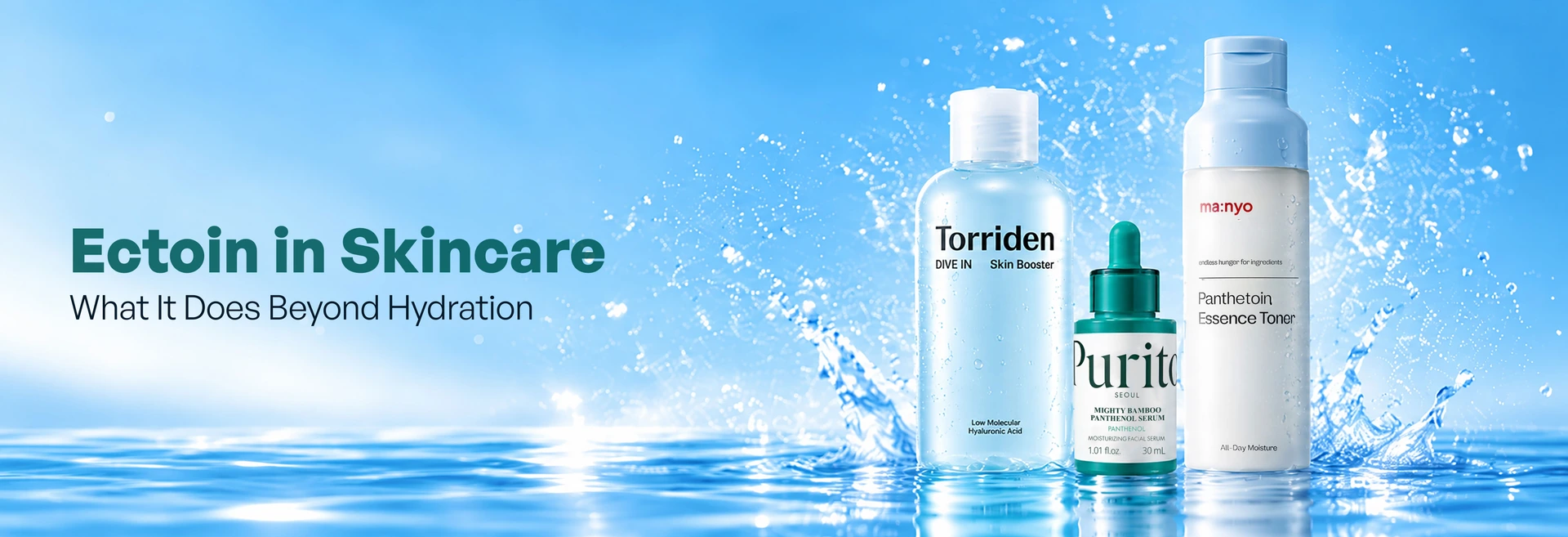
The four Korean products below include ectoin in their formulas. Panthenol, glycerin, emollients and other ingredients also contribute to how each formula performs.
If you have persistent itching, cracking, inflamed patches or diagnosed eczema, seek appropriate medical advice rather than treating a cosmetic ingredient as a substitute for care.
Ectoin, hyaluronic acid and ceramides are not interchangeable
These ingredients can appear in the same bottle because their roles overlap without being identical.
| Ingredient | Its main role in a moisturising formula | What to keep in mind |
|---|---|---|
| Ectoin | Water-binding support, with research into barrier-related comfort and protection | Evidence from one concentration or formula does not prove another product performs the same way |
| Hyaluronic acid | Helps attract and hold water | A hydrating layer may still need a suitable moisturiser over it |
| Ceramides | Lipids used to support the skin’s moisture barrier | The wider lipid blend and formulation matter, not just the ingredient name |
| Panthenol | Humectant and skin-conditioning support | Often paired with ectoin; a benefit cannot automatically be credited to ectoin alone |
There is no need to choose a winner. If a hyaluronic acid serum and your usual moisturiser already leave skin comfortable, ectoin is optional. If you are shopping for a replacement, it can be a useful supporting ingredient to look for rather than a reason to add another step.
For a closer look at the lipid side of moisturising, our Korean ceramide skincare guide explains where ceramide-containing formulas fit.
Four Korean formulas that contain ectoin
The useful way to shop this ingredient is by the step you actually need. The products below are alternatives with different formats, not a four-step routine you must buy together. Each combines ectoin with supporting ingredients suited to its place in a routine.
A hydrating first layer: Torriden DIVE IN Skin Booster
Torriden DIVE IN Low Molecular Hyaluronic Acid Skin Booster brings together several forms of hyaluronic acid with glycerin, panthenol, ceramide NP and ectoin. It makes sense as an option for someone who wants a hydrating toner-style step rather than another targeted treatment.
Its ingredient list also includes witch hazel and several botanical extracts. That does not make it unsuitable by default, but it is worth checking if you already know particular extracts do not agree with your skin. An ectoin-containing formula is not automatically the simplest formula.
Use it as your chosen hydrating layer after cleansing, then follow with a moisturiser as needed. You do not need to add the ma:nyo toner below on top.
A panthenol-led serum: PURITO Seoul Mighty Bamboo Panthenol Serum
PURITO Seoul Mighty Bamboo Panthenol Serum puts panthenol near the start of its ingredient list, alongside glycerin, niacinamide, squalane, bamboo extract, ectoin and allantoin. Its lightweight serum format makes it an option if you prefer your moisturising support in a serum step.
Panthenol, humectants and emollients complement ectoin in this moisturising blend. Likewise, the presence of niacinamide matters if that ingredient has previously bothered your skin, even though many people use it comfortably.
Choose it to replace a serum that is not meeting your needs, rather than automatically layering it with two other hydrating serums.
An essence-toner option: ma:nyo Panthetoin Essence Toner
ma:nyo Panthetoin Essence Toner combines ectoin with panthenol, allantoin, hydrolysed hyaluronic acid, squalane and ceramide NP. Its formula also lists sunflower and macadamia seed oils, so it is worth considering when you want more than a basic water-and-humectant toner.
The name “Panthetoin” is not a separate ingredient you need to decode before using it: check the ingredient list for the individual components. Nor should the name be read as a disclosed ectoin percentage.
This is an alternative to the Torriden booster, not a required companion. If your current toner is already comfortable and your moisturiser does the rest, you can skip an essence-toner purchase altogether.
An occasional mask: ma:nyo Panthetoin Deep Moisture Mask
ma:nyo Panthetoin Deep Moisture Mask offers ectoin in a sheet-mask format with panthenol, squalane, ceramide NP and hyaluronic acid ingredients. Its creamy essence makes this an occasional-care option alongside your daily routine.
A sheet mask is not essential for getting ectoin into your routine. Follow the pack’s wear-time instructions, remove it as directed and do not leave it on overnight. If your skin is already irritated, a new mask with a long ingredient list is not necessarily the best experiment that evening.
How to add ectoin without overcomplicating your routine
Start with the gap, not the ingredient trend.
- Your skin feels comfortable already: keep the routine. There is no requirement to add ectoin.
- You want a hydrating toner: consider one of the toner-style options, not both.
- You prefer fewer watery layers: a serum may be the more convenient format.
- You only want occasional extra care: a mask is an option, but it does not replace a dependable daily moisturiser.
A simple morning routine can be cleansing as needed, one optional hydrating layer, moisturiser if needed, and broad-spectrum sunscreen. At night, cleanse and use your chosen hydrating product and moisturiser. Follow the individual products’ instructions rather than assuming more layers produce better results.
Ectoin is not itself a retinoid or exfoliant, so it does not call for an exfoliation schedule. However, that does not prove every ectoin-containing formula is compatible with every treatment or every person’s skin. Introduce one new product at a time and patch test first. Stop if you develop burning, a rash or worsening discomfort.
If a prescribed treatment is making skin sore, ask your clinician how to manage it. Adding a soothing-sounding serum is not a reason to keep pushing through irritation.
Ectoin questions, answered
Is ectoin the same as ectoine?
Yes. You will see both spellings in skincare and research. Ectoin is the name to look for in the ingredient lists discussed here.
Is it better than hyaluronic acid?
There is no universal winner. Hyaluronic acid is a familiar humectant; ectoin offers water-binding support with research into barrier-related benefits. They can be formulated together. Pick the product that suits your skin and the step you need, not the ingredient with the newer name.
Can sensitive skin use it?
Ectoine-containing preparations have been studied in people with impaired skin barriers, but sensitivity to a finished cosmetic is still possible. Check the whole formula, patch test and avoid assuming “soothing” means allergy-proof.
Does an ingredient list tell me the ectoin percentage?
No. Seeing ectoin on the list confirms its presence, not a precise concentration or a study-equivalent dose. None of the product recommendations above depends on an assumed percentage.
Will it treat acne, pigmentation or eczema?
The products in this guide are selected as moisturising cosmetics, not treatments for those conditions. Do not replace an appropriate treatment plan with an ectoin-containing toner or mask.
The takeaway
Ectoin is worth understanding, but it does not demand a new routine. Think of it as a supporting ingredient in a formula you would otherwise want to use: a toner that fills a hydration gap, a serum that suits your preferences, or an occasional mask.
The useful upgrade is a product that leaves your skin feeling comfortable without unnecessary layers. If you already have that, you are not missing a mandatory step.