
Your skincare looks fine until the last step. Then sunscreen rolls into tiny grey crumbs along your jaw, or foundation lifts little strings from your cheeks. Adding another layer rarely makes that morning feel better.
This is product pilling: skincare or makeup gathering into small flakes or balls on the surface. It is not, by itself, proof that your skin needs exfoliating, that every product has stopped working, or that one ingredient is incompatible with your face.
The useful response is a small troubleshooting exercise, not a new ten-step routine. Find the stage where the rolling begins, change one thing, and keep sun protection non-negotiable.
First, distinguish rolling product from peeling skin
Pilling often becomes obvious while you are spreading a product or going over an area again. The residue gathers under your fingertips, particularly where several layers meet.
Peeling skin can be visible before you apply anything. It may come with tightness, soreness, redness or stinging. The two can coexist, so appearance alone is not a diagnosis. If skin is uncomfortable or persistently flaky, stop experimenting with stronger exfoliants and seek professional advice if it continues.
Do not scrub away the crumbs to make the next layer behave. Extra rubbing can make an already frustrating application worse, while an exfoliating acid is not a reliable remedy for a formula-layering problem.
What research actually tells us about pilling
A 2024 study in Skin Research and Technology assessed pilling in 528 women using test base formulas, a sunscreen and a foundation. Participants had different experiences: some pilled with sunscreen alone, some only when it was layered, and others improved when a base formula was used underneath. Rubbing motions were associated with the largest numbers of pilling events.
That is more useful than a blanket rule that all moisturisers cause sunscreen to roll. The study suggests that skin condition, the finished formulas and application method can all matter. It does not identify one universal culprit or prove that any product featured below will prevent pilling.
There are limits, too. This was a particular study population and set of formulas, and the research was funded by Clarins. Its findings are a starting point for troubleshooting, not a compatibility test for everything in your bathroom.
A practical reset: simplify everything except sunscreen coverage
Try this on an unhurried morning, before committing to a full face of makeup.
- Start with clean, comfortable skin. Use your usual gentle cleansing approach. Avoid adding a scrub just for this test.
- Keep the base familiar. If your skin needs moisturiser, use one you already tolerate. Temporarily leave out optional essences, extra serums and primer so you have fewer variables.
- Let the preceding layer settle. If it still feels wet or moves around under your fingers, pause before adding sunscreen. There is no single waiting time that guarantees every formula will cooperate.
- Apply sunscreen as directed on its label. Spread it gently and evenly over exposed areas. Do not keep polishing the same patch once an even layer is in place.
- Observe before makeup. If rolling has already started, the foundation is not the first step to investigate. If it begins only with makeup, test your application technique or primer separately on another day.
This is an editorial troubleshooting approach, not a clinically validated protocol. Its purpose is to isolate variables. Keep prescribed treatments as directed by your clinician rather than dropping them to follow a cosmetic experiment.
Do not solve pilling by using less sunscreen
The American Academy of Dermatology advises choosing broad-spectrum, water-resistant sunscreen with SPF 30 or higher, applying it before going outdoors and using enough to cover exposed skin. When outdoors, reapply every two hours and immediately after swimming or sweating, following the product’s directions.
Reducing sunscreen until it disappears beautifully is not the goal. Nor is mixing it into moisturiser or foundation to make the texture easier to spread. Keep it as its own step and follow the pack instructions. A neat makeup finish does not tell you how much UV protection remains.
If substantial sunscreen is visibly lifting or coverage looks patchy, do not assume you can buff away the residue and retain the labelled protection. Gently remove the affected layers and reapply sunscreen according to its directions before sun exposure. Shade and protective clothing are useful while you sort out the routine.
If the problem starts under sunscreen: test a smaller base
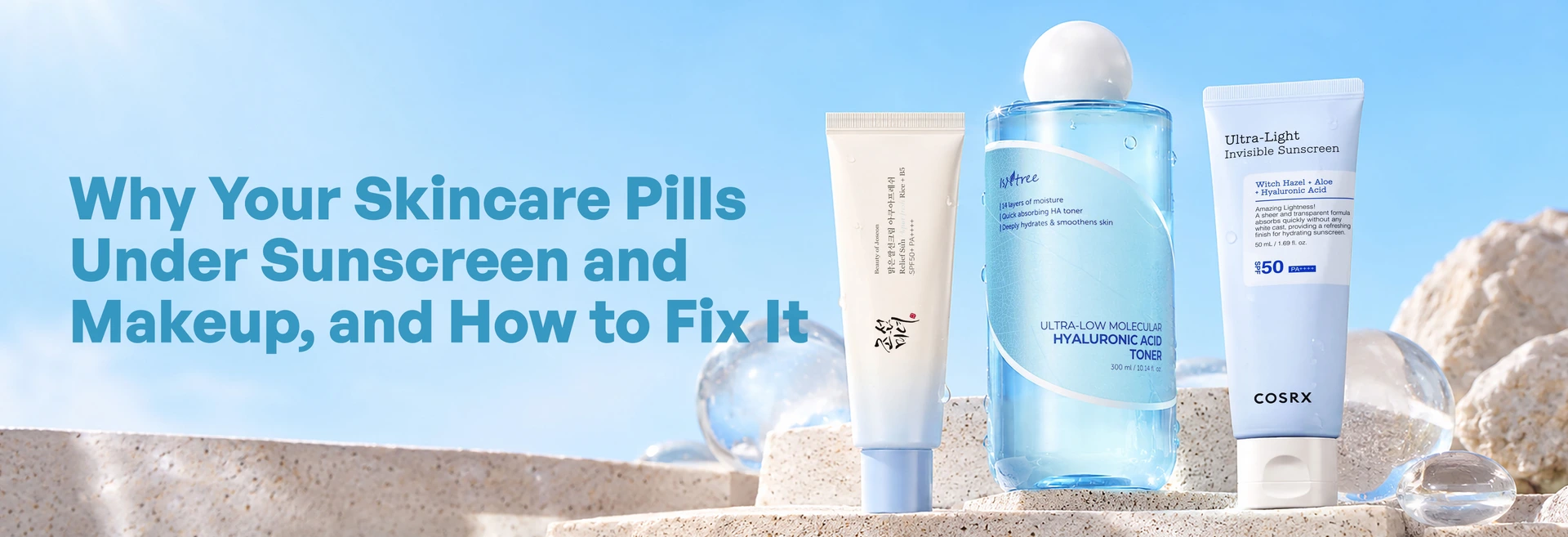
A hydrating toner is an optional step, not an automatic solution to rolling sunscreen. Keep a moisturiser you already tolerate if your skin needs it; you do not need a new cream just to troubleshoot pilling. This Korean toner illustrates a lighter hydration format to consider only after trying the reset with what you own.
Isntree Ultra-Low Molecular Hyaluronic Acid Toner
Isntree’s Ultra-Low Molecular Hyaluronic Acid Toner is a water-based hydration step. SkinSeoul’s ingredient record lists glycerin, several forms of hyaluronic acid, betaine and panthenol. Its catalog describes a refreshing texture with minimal oiliness.
Consider it if you enjoy a light hydration layer, rather than applying several toners and essences together. A toner is optional and is not automatically enough moisturising care for dry skin. The ingredient list cannot tell you whether it will pill with the sunscreen you already use.
If sunscreen itself keeps rolling: compare one alternative at a time
If the same sunscreen pills in a simplified routine, trying a different finished formula is a reasonable next experiment. These are alternatives, not two sunscreens to stack together, and neither has been tested by us for pilling with your skincare or makeup.
COSRX Ultra Light Invisible Sunscreen
The COSRX Ultra Light Invisible Sunscreen SPF50+/PA++++ is described in SkinSeoul’s catalog as a lightweight, moisturising sunscreen with a serum-like feel. The listed key ingredients include aloe leaf water, niacinamide and sodium hyaluronate.
That texture positioning makes it an option to investigate if you dislike a heavy-feeling morning finish. The word invisible does not establish how it will look on every complexion or behave under every foundation. Check the current packaging for directions, ingredients and water-resistance information.
Beauty of Joseon Relief Sun Aqua-Fresh: Rice + B5
Relief Sun Aqua-Fresh: Rice + B5 SPF50+/PA++++ is positioned in SkinSeoul’s catalog as a quick-absorbing sunscreen for combination and oily skin. Its ingredient record includes rice-derived ingredients and panthenol.
Use the exact Aqua-Fresh listing and packaging when comparing it: this is a named variant, not a claim that every Beauty of Joseon sunscreen has the same finish. A lighter-feeling sunscreen can still roll with a particular base or repeated rubbing. Keep the rest of your routine unchanged when testing it so the comparison tells you something useful.
If pilling appears only after makeup
Wait until the sunscreen layer has settled according to its directions before applying makeup. Then try gentle tapping rather than repeatedly dragging a brush or sponge over the same area. If you use a separate primer, test without that optional step on another day.
Do not assume a water-versus-silicone label will solve the whole problem. Finished products contain multiple ingredients; the combination on your skin matters more than a simple ingredient-family sorting exercise. Likewise, adding face oil to force everything to glide changes another variable and may disturb the layers you are trying to preserve.
A useful note in your phone is enough: which base you used, whether sunscreen rolled before makeup, and which motion first lifted residue. You are looking for a repeatable pattern, not a perfect-looking ingredient blacklist.
The takeaway: fewer variables, less friction
When skincare pills, resist the urge to buy an entire replacement routine. First work out when the rolling starts. Keep skin comfortable, remove optional layers, let the base settle and avoid overworking the finish. Change one product only when that simpler test gives you a reason to.
The products here are catalog-based options, not a tested anti-pilling set. Availability, formulations and packaging can change, so check the current listing and label before buying. The best result is not merely a smoother foundation application. It is a routine you can repeat without sacrificing comfortable skin or proper sunscreen use.