
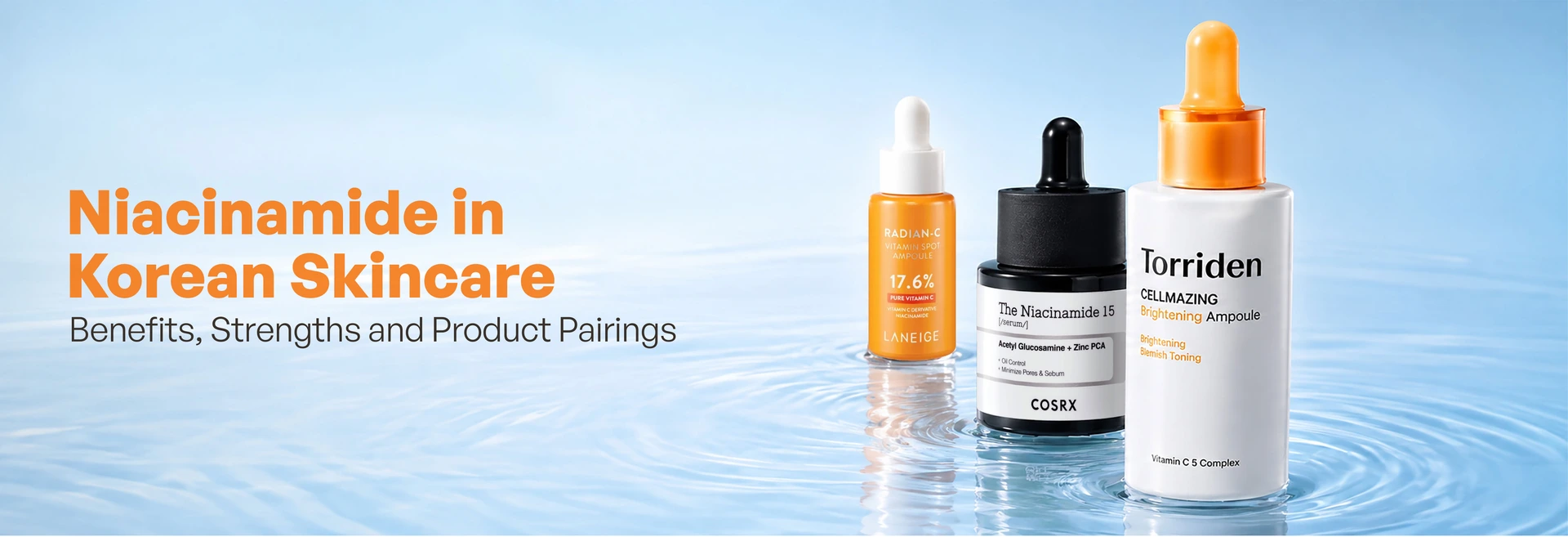
Niacinamide has become the quiet overachiever of Korean skincare. It turns up in brightening serums, pore treatments, moisturisers, sunscreens and even sheet masks, often without demanding the spotlight. Unlike ingredients built around one dramatic promise, this form of Vitamin B3 is valued for doing several useful jobs at once: supporting the skin barrier, balancing the look of excess oil, softening the appearance of pores and helping uneven tone look clearer over time.
That versatility can make shopping confusing. Is 15% automatically better than 5%? Should niacinamide be paired with Vitamin C, tranexamic acid or peptides? And if it already appears halfway down the ingredient list in your moisturiser, do you need a separate serum at all?
The answer starts with your skin goal—not the largest number printed on the bottle.
What does niacinamide actually do?
Niacinamide is a water-soluble form of Vitamin B3 used in topical skincare. It supports the production of ceramides and other lipids that help the outer skin barrier retain moisture. A better-supported barrier is less likely to feel tight, rough or reactive after cleansing.
It is also widely used to improve the appearance of uneven tone. Rather than exfoliating pigment away, niacinamide helps interrupt the transfer of pigment-containing structures to surface skin cells. The effect is gradual, which is why consistent daily use matters more than one aggressive application.
For combination and oily skin, niacinamide can help reduce the look of shine and enlarged pores. It does not physically close pores—pores do not open and shut—but more balanced oil and smoother-looking texture can make them appear less prominent.
The ingredient also has a reassuringly broad compatibility profile. Many people can use it morning or night, and it fits comfortably beside hydrators, peptides, ceramides and sunscreen. High-strength formulas can still sting or cause flushing, especially on a compromised barrier, so “gentle” should never be mistaken for “impossible to overdo.”
Choosing a niacinamide strength
A concentration around 2–5% is a sensible starting range for barrier support, mild oil balancing and gradual brightening. It is often enough for sensitive skin or for someone already getting niacinamide from several routine steps.
Formulas around 10% are more targeted. They may suit people focused on visible oiliness, pores or post-blemish marks, provided the rest of the routine is not overloaded with strong actives.
At 15% or higher, niacinamide becomes a specialist treatment rather than a universal upgrade. These formulas can be useful for experienced users, but they are not automatically faster or more effective for every complexion. If a lower concentration keeps your skin calm enough for daily use, it may produce the better long-term result.
Always look beyond the percentage. Zinc PCA can make a formula feel more oil-focused; panthenol, hyaluronic acid and squalane add comfort; Vitamin C derivatives, tranexamic acid and glutathione move the product toward a pigmentation-focused routine.
For a high-strength pore and oil routine
The COSRX Skin Booster & Niacinamide 15 Serum Special Set pairs a 6 Peptide Skin Booster Serum with a 15% niacinamide serum. The first step brings hydration, amino acids and peptides; the second adds concentrated niacinamide with Zinc PCA for the look of excess sebum and pores. This is a logical choice for experienced users who want a structured two-step routine rather than layering several unrelated treatments.
Because 15% is a purposeful strength, begin with the niacinamide serum every other evening. Apply a small amount after the booster, then follow with moisturiser. If your skin becomes persistently hot, itchy or unusually dry, reduce the frequency rather than trying to “push through.”
For dark spots and uneven-looking tone
Niacinamide often works best as part of a brightening team. The Nature Republic VITAPAIR C Dark Spot Serum combines niacinamide with tranexamic acid, ascorbyl glucoside, glutathione and panthenol in a non-sticky gel texture. Its 79.9% Jeju green lemon base gives the formula a fresh, antioxidant-focused identity, while the supporting ingredients keep the goal firmly on clearer-looking tone.
The Torriden Cellmazing Vita C Brightening Ampoule takes a similar multi-path approach with niacinamide, several forms of Vitamin C and ferulic acid. It is designed around three visible concerns—spots, pores and overall tone—and adds panthenol and allantoin for a more cushioned feel. Combination skin may appreciate its light ampoule texture; sensitive skin should still patch test because the formula also contains bergamot fruit oil.
Neither formula should be treated as a spot eraser. Apply a thin, even layer to the face, not only to individual marks, and measure progress over eight to twelve weeks. Daily sunscreen is essential because ongoing UV exposure can undermine any brightening routine.
When Vitamin C takes the lead
Niacinamide and Vitamin C can be used together. The old idea that they always cancel each other out came from conditions that do not reflect modern cosmetic formulas or normal bathroom use. The more practical question is whether your skin tolerates the combined intensity.
The LANEIGE Radian-C Vitamin Spot Ampoule is clearly a Vitamin C treatment first. It contains 17.6% pure Vitamin C alongside niacinamide, tranexamic acid and glutathione. That makes it a concentrated option for established brightening routines, not the gentlest place to begin. Use it according to the product directions, keep the rest of the routine simple and store it carefully to limit oxidation.
The Dr. G RTX Into Serum Vitamin Shot offers a larger, fast-absorbing serum format with niacinamide, ascorbic acid, adenosine, sodium hyaluronate and squalane. It targets radiance and texture while adding humectant and emollient support. Because the formula uses Vitamin C-coated spicules, a prickling sensation may be part of the experience; avoid applying it to irritated skin or on the same night as strong exfoliating acids or retinoids.
A mask-night option for extra hydration
The Anua Niacinamide TXA Dark Spot Serum Mask delivers 5% niacinamide with tranexamic acid, glutathione, panthenol and several forms of hyaluronic acid. A sheet mask cannot replace a consistent daily serum, but this one can make sense before an event or whenever dehydrated skin needs a comfortable brightening step.
Leave the sheet on only for the recommended time. Keeping it on until completely dry can make skin feel tighter rather than more hydrated. Press in the remaining essence, then finish with moisturiser. The mask also contains betaine salicylate, so use caution if your routine already includes exfoliating acids or if your barrier feels unsettled.
Can you use niacinamide with retinol, acids and Vitamin C?
With retinol or retinal: Yes. Niacinamide’s barrier-supportive role can complement a Vitamin A routine. If you are new to either active, introduce them on separate nights first so you can identify the cause of any irritation.
With Vitamin C: Yes. Many well-formulated products intentionally combine them. Sensitive skin can use Vitamin C in the morning and niacinamide at night if applying both together feels too intense.
With AHAs, BHAs or PHAs: Usually, but the combined routine may be more irritating than either product alone. Keep exfoliation measured and avoid using several high-strength products in the same session.
With tranexamic acid or alpha arbutin: These are common pigmentation-focused pairings. More ingredients do not guarantee a faster result, so choose one coherent formula or a simple two-product routine rather than stacking every brightening serum you own.
A simple niacinamide routine by skin type
Oily or combination skin: Cleanse gently, apply a light 5–10% niacinamide serum, then use a gel moisturiser and broad-spectrum sunscreen. A 15% formula can be introduced gradually if pores and shine remain the priority.
Dry or dehydrated skin: Choose a formula that combines niacinamide with glycerin, panthenol, hyaluronic acid, squalane or ceramides. Seal it with moisturiser rather than expecting a water-based serum to prevent moisture loss by itself.
Sensitive skin: Start with a lower concentration and use it two or three times a week. Avoid introducing niacinamide on the same day as a new acid, retinoid or strong Vitamin C product. Patch test, then increase only when the skin remains comfortable.
Post-blemish marks: Pair niacinamide with sunscreen and one well-chosen brightening partner such as tranexamic acid or a Vitamin C derivative. Do not confuse post-inflammatory marks with indented acne scars, which usually need professional treatment rather than topical brighteners alone.
Common mistakes to avoid
The first mistake is assuming that tingling means a product is working. Persistent stinging, redness or itching is a signal to stop and reassess. The second is layering niacinamide across a toner, essence, serum, cream and sunscreen without noticing the cumulative load. Each individual product may be mild, but the full routine can become unnecessarily repetitive.
The third is judging progress too quickly. Oil balance may change sooner, while uneven tone often needs weeks of consistent use. Take photos in the same lighting once a month rather than scrutinising the mirror every morning.
Finally, do not let a brightening routine distract from sunscreen. Niacinamide can support clearer-looking tone, but it cannot compensate for repeated unprotected exposure.
The verdict
Niacinamide earns its place in Korean skincare because it is adaptable, not because it is dramatic. A lower-strength formula can quietly support the barrier and refine everyday texture; a 10–15% treatment can focus more directly on oil, pores and stubborn unevenness; a carefully paired formula can join Vitamin C or tranexamic acid in a broader brightening strategy.
Choose the simplest concentration that matches your goal, introduce it gradually and give it time. The best niacinamide product is not the strongest one—it is the one your skin is comfortable using consistently.